
13 Jan 2026
Scientists analyse Darwin’s Original Specimens Without Opening 200-Year-Old Jars
FOR IMMEDIATE RELEASE
Scientists have successfully analysed Charles Darwin’s original specimens from his HMS Beagle voyage (1831-36) to the Galapagos Islands without opening their 200-year-old preservation jars.
The study examined 46 historic specimens at the Natural History Museum, London, including mammals, reptiles, fish, jellyfish, and shrimps collected by Darwin and other naturalists.
It was found that traditional preservation methods differed by species and era: mammals and reptiles were typically fixed in formalin and stored in ethanol, while invertebrates might be kept in formalin, buffered solutions, or mixtures containing additives like glycerol.
The achievement addresses a long-standing challenge for museums worldwide: how to monitor the condition of preserved specimens without exposing them to contamination, evaporation, or environmental damage that comes from opening their containers.
For collection curators, knowing the exact composition of these fluids is essential for monitoring specimen condition.
“Until now, understanding what preservation fluid is in each jar meant opening them, which risks evaporation, contamination, and exposing specimens to environmental damage,” says Dr Sara Mosca, STFC Central Laser Facility. “This technique allows us to monitor and care for these invaluable specimens without compromising their integrity.”
The researchers used a portable laser spectroscopy method called Spatially Offset Raman Spectroscopy (SORS) to peer through glass and identify the chemical composition of preservation fluids.
SORS performs chemical analysis by shining a laser light into a container and inspecting the changes in wavelength that occur when the light is reflected. These changes indicate the presence of different chemical components within it.
SORS, originally developed at STFC’s Central Laser Facility, is the same technique which is used in airport scanners all over the world through Agilent Technologies.
The technique correctly identified fluids in approximately 80% of cases tested, with partial identification in another 15%. It also determined the types of glass or plastic containers used, providing insights into how storage methods have evolved over time.
With over 100 million fluid-preserved specimens housed in museums worldwide, the ability to analyse preservation fluids non-invasively offers conservators and curators a new tool for monitoring collection health and intervening before problems arise.
The research was conducted by a collaboration between the Science and Technology Facilities Council, the Natural History Museum and Agilent Technologies.
“As part of NHM Unlocked, here at the Museum we can analyse jars containing specimens without opening and disturbing their integrity,” says Wren Montgomery, research technician at the Natural History Museum. “This work is the next step in demonstrating the Museum’s commitment to transforming the study of natural history. Analysing the storage conditions of precious specimens, and understanding the fluid in which they are kept, could have huge implications for how we care for collections and preserve them for future research for years to come.”
The study has been published in ACS Omega and featured as the ACS Editors\' Choice on 13 January, 2025, and can be found here: https://pubs.acs.org/doi/10.1021/acsomega.5c09045
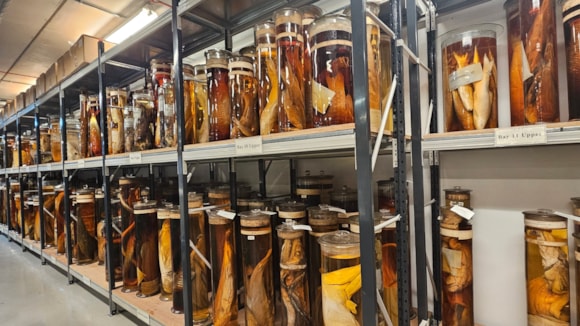
Image: Specimens preserved in jars at the Natural History Museum. Credit: Sara Mosca, STFC Central Laser Facility
Contact Information
Jake Hepburn
jake.hepburn@stfc.ac.uk
Notes to editors
About Natural History Museum
The Natural History Museum is a world-leading scientific research centre and one of the world’s most visited museums. Our mission is to create advocates for the planet – people who act for nature.
Our 400 scientists are finding solutions to the planetary emergency - from reversing biodiversity loss to resourcing the green economy.
We are seeking an additional £150 million to transform our South Kensington building: placing our ground-breaking research at its heart, revitalising four existing galleries, opening two new magnificent galleries and delighting 1 million more visitors a year with the wonders of the natural world.
About the Science and Technology Facilities Council
The UKRI Science and Technology Facilities Council (STFC) funds and supports research in particle and nuclear physics, astronomy, gravitational research and astrophysics, and space science. It also operates a network of five national laboratories as well as supporting UK research at a number of international research facilities including CERN, FERMILAB and the ESO telescopes in Chile. STFC is keeping the UK at the forefront of international science and has a broad science portfolio and works with the academic and industrial communities to share its expertise.
Find out more at https://www.ukri.org/councils/stfc
Downloads

Powered by Onclusive PR Manager © 2026